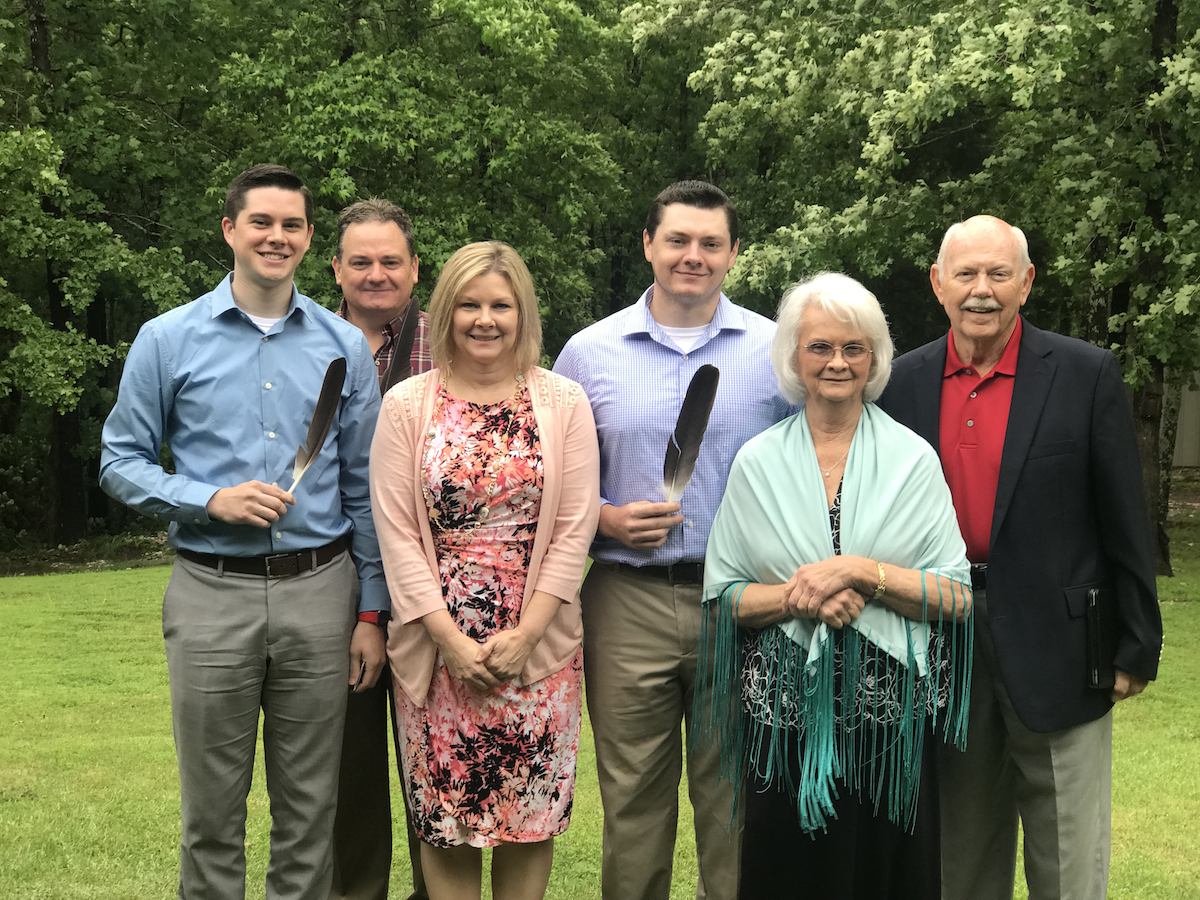
Today was a day my family and I have been looking forward to for a long time. We were receiving our Indian names.
I know, it sounds weird. Let me answer some of your questions:
- You’re Indian? Yes. My family and I are members of the Citizen Potawatomi Nation (CPN). In 1720, a guy named Anaquiba was born. He had a son (Chief Topenbee), who had a daughter (Madeline), who had a daughter (Julia), who had a son (Lewis), who had a son (William), who had a daughter (Matilda Grace), who had a daughter (Janice), who had a son (Mark), who had me. We are of the Higbee family line.
- How much Indian are you? I don’t know, nor does it really matter. CPN records are based off family line and not blood degree. Plus, with both of my parents being from Oklahoma, there is likely Indian blood mixed in here and there that we don’t know about. But I am a 100% member of CPN just the same as any other descendant.
- What is an Indian name? It’s a Potawatomi word that is selected for you based off who you are — your personality, interests, family, etc.
- How do you get an Indian name? The naming process follows Potawatomi traditions. You must formally request your name from somebody who has already been named. A formal request consists of asking the person if they will name you and presenting them with a gift of tobacco. A formal naming ceremony will follow.
When I decided to make a #25before25 list, I knew this had to be one of the things on the list. So my dad and I did a little research on the naming process and made our formal request to Eva Marie Carney, the District #2 legislator for CPN. Eva accepted our request and we began to work out the logistics; she is based out of the Washington, D.C. area, so we had to wait for an opportunity for her to come to Arkansas. We settled on today — April 30, 2017.
My dad, brother and I would be named, so we began talking to Eva and filling out a questionnaire so she could choose our name.
This morning, we all gathered at my parents’ house for the formal naming ceremony. We were joined by another Potawatomi from Little Rock, Delores, who would be receiving her name with us.
We set up a traditional prayer circle, centered with a fire and surrounded by chairs. According to Potawatomi tradition, an entry/exit opening is left on the eastern side of the circle. A Potawatomi woman (my grandma) spread cedar leaves around the outside of the circle before we began. Eva mixed together a traditional blend of cedar, sage, tobacco and sweetgrass in a wooden bowl and lit it. She entered the circle and, starting in the east, fanned the smoke with an eagle feather fan in each direction — east, south, west and north. Then she fanned each person with the smoke as an act of cleansing.
Before each person entered the circle, they would take a spoonful of water from a wooden bowl and pour it onto the ground, offering the water back to Mother Earth. You would then grab a handful of tobacco leaves with your left hand and enter the circle, walking clock-wise. Once you reach your spot, you are to hold the tobacco that’s in your left hand to your heart, stand and face each direction and say a prayer. You can then take your seat.
Once everyone was seated, the ceremony began with a traditional prayer spoken in Potawatomi. Another eagle feather, the talking feather, was passed around and each person had an opportunity to say a few words about the morning, about the individuals being named, etc. while they held the talking feather. Once everyone had spoken, Eva read a few passages from a book explaining the significance of receiving a Potawatomi name. The significance dates all the way back to Adam and his responsibility from the Creator in naming everything on the earth (the Potawatomi are a tribe seeded in Christian and Catholic faith). It is also said in Potawatomi culture that the Creator does not see your face until you are given your name and presented to Him.
Once she explained the significance and the process, Eva called us one-by-one to receive our name. Each person, along with two people they had chosen as sponsors (à la godparents; a man and a woman who have made a significant impact in your life) stands before the namer as the namer explains what the name means and how they chose it for that person. The namer officially presents your name by holding an eagle feather over your heart and saying your name. You repeat the name back to the namer, and then thank them by saying migwetch, the Potawatomi word for “thank you.”
After you have received your name, everyone in the prayer circle stands and faces east, and you all say your name out loud. You repeat this facing south, west and north. This is the act of introducing you to the Creator, the spiritual world and Mother Earth. Once your sponsors accept their responsibility, you walk back to your seats clockwise.
The ceremony is capped off by a feast prepared by the named and their family.
And without further adieu:
- My dad’s name is Zhawensen (zjow-in-sin). Meaning “southern rock,” it was chosen for him as the foundation of the family — in heritage, in faith, in being a father.
- My name is Netmozhan (net-moe-zjohn). Meaning “first-born child,” it was chosen for me as the person responsible for leading the next generation of our family.
- My brother’s name is Gawset (gow-set). Meaning “hunter,” it was chosen for him as a life-long lover of hunting and as a competitive shooter.
Receiving a Potawatomi name is so much more than just receiving a name. It is a cornerstone of our heritage as Potawatomi. It is another step towards connecting with our family roots. It is an opportunity to bring alive past traditions that have become lost to time.
It was a great honor to receive my Potawatomi name, and it’s something that I can carry with me for the rest of my life. It is something I look forward to doing for my children and grandchildren someday. I am proud to have been able to share the experience with my dad and brother, as well as my family and friends that attended. It’s something that we will never forget.
Thank you again to Eva for taking the time to name us and travel to Arkansas for the ceremony. We respect and appreciate the work you do for the Nation as a legislator. We are proud to be Potawatomi.
Hi, I’m Netmozhan. It’s nice to meet you.

 Tanner Ward